Trip to Sunset Park

Last week my group and I went to visit sunset park for our grand proposal. On our way to Sunset park, Brooklyn we tried to see where we were going to start first. We ended up starting at the furthest place and worked our way through sunset park to our destinations. Our first destination was Greenwood cemetery, this is a historical spot in sunset park that has been there for years. Then we decided to go to the Brooklyn army terminal which is now converted into buildings that contain many stores and companies.

As we were making our way through Sunset park and the avenues changed so did the people. First, we started on 4th and 5th avenue and between 30th and 65th st and it was inhabited by Spanish and Dominicans. As we went up toward 7th and 8th avenue we ended up in whats known as Brooklyn’s “China Towns”. Every store was written in Chinese and as we walked around we saw the variety of different fresh fruits, vegetables and fish they sold.

Before going to Sunset park Dr. Nolan had emailed my group a news article talking about some dumpling spots that are popular in sunset park. My group and I ventured out and went to one of greatly reviewed dumpling spots. As we approached Kai Feng Fu Dumpling House we were hesitant at first because it was a small place on a side block but we went in and the dumplings were delicious!! I really enjoyed venturing out to Sunset park because I was able to see and experience a different neighborhood other than mine.

IMG_1247-1IMG_1253-1

Social Media

Every single person who has Instagram or Facebook can say that they follow some sort of food related account. Whether it is “NYC Foods,” “FoodPorn,” or any other food related account, those pictures of deliciously looking foods that pop up on our news food are constantly making us crave junk food more and more. Every time I open the Instagram app there is a new picture of chocolate sundae with sprinkles and melted hot fudge followed by a picture of a double bacon cheeseburger with every possibly topping and sauce ever created. Whether you’re hungry or not, seeing that automatically makes you crave it – also referred to as food cues. We never really notice it and realize how much these accounts impact the amount and choice of food. For example, my friend and I were sitting at home the other day trying to decide where we’d like to go eat. We spent about 45 sitting down on the couch scrolling through Instagram seeing if that could expedite the decision making process. However, that probably wasn’t the best idea. As soon as we came across one of these food accounts that displayed a picture of a curly fries tower with melted cheese and bacon bits on it we realized that thats what we wanted. But looking back on the situation I think to myself, is that really what we wanted, or did we just immediately crave it after seeing the picture? It’s really hard to say. Social media has such an incredible impact on the food choices we make today in positive and negative ways. When we see celebrities eat healthy and make nutritional food choices it often makes us want to do the same so we can look and feel as good as they do. However, when we see posts about stuffed nutella french toast and mac n cheese burger we are more inclined to crave that rather than a salad with celery and cucumbers.

Halloween Candy

I’ve always gone Trick-Or-Treating. This isn’t my first year not going completely (I dressed up but didn’t go once when I was really sick. Another time we had a huge storm and Halloween was delayed in my town, so I went later.), but it still feels weird.

So I figured this would be an appropriate time to discuss Halloween candy. I was watching It’s the Great Pumpkin, Charlie Brown last night (because what else do college students do on Fridays?) when I noticed something about the way kids went trick-or-treating in 1966. Besides giving out rocks (poor Charlie Brown) they received cookies, apples, popcorn balls, and cakes with the typical candy treats. Now-a-days, giving out baked goods and non-prepackaged foods is unheard of, even receiving a Rice Krispy Treat or package of Oreos is a little weird. It’s considered unsafe to eat things made by other people for Halloween. Parents are even advised to check every single package for small holes that could indicate something injected into the candy, and for knives and pieces of glass thrown into bags. And some areas hold “trunk-a-treating,” where families decorate their cars in parking lots and hand out candy. Sometimes it’s only kids from a certain neighborhood or the schools set it up. I asked my mom about this change, and she thinks parents are definitely a lot more paranoid about it than they were when It’s the Great Pumpkin, Charlie Brown was released (she was born a few years before.) While she said she definitely went through my candy and threw out anything that looked suspicious, her trick-or-treating experience was more like the movie.

Halloween wasn’t always about the candy. According to an article in the Smithsonian magazine, trick-or-treating wasn’t popular until the 1950s and 60s. The documentary we watched in psychology said snacking became popular around this time. The food industry started advertising for Halloween, somehow turning it into a holiday all about treats in just a few decades. With even more heavy advertising, everything handed out became candy. No homemade goods, toys, or small amounts of money. More candy means more sugar.

This year, it is projected Americans will spend $6.9 billion for this Halloween. 4 billion of that is spent on candy, and 4% of all candy consumed in one year is consumed on Halloween. Kids LOVE that Halloween candy, as demonstrated in Jimmy Kimmel’s Youtube challenge, ‘I Told My Kids I Ate All Their Halloween Candy‘ (but who can blame them, trick-or-treating in my neighborhood was A LOT of walking.) There are now other options for parents who don’t want to give their kids this candy. Dentists have candy buy-backs and some organizations have donations, such as Operation Gratitude. I know I participated in Trick-Or-Treat for Unicef in elementary school, in which I carried around a box and asked for quarters, but I still got candy. Parents could have their children opt out of the candy and only ask for donations, but that’s not very likely. While watching on of my favorite TV shows, Shark Tank, the other day, I learned parents are making up Tooth Fairy like characters for Halloween. Switch Witch is a story book and stuffed animal that’s like Elf on the Shelf or Mensch on the Bench and hangs out around the house for a month. Kids still get the fun of trick-or-treating, but all of their candy is given to the Switch Witch, who brings them a present the next morning. I personally think it’s a genius idea, but the sharks didn’t agree.

In America, Halloween is the second most profitable holiday, second only to Christmas. Halloween spending has definitely gotten higher since the 1960s, and the way we celebrate has changed drastically, especially for kids. I guess we’re not as willing to wait for the Great Pumpkin anymore.

Mentoring

20151023_123620On Friday, October 23 I visited my mentee named Rebecca at Port Richmond High School. When the class bell rang, the students got straight to work. It was so interesting to see all of them grabbing pots, pans, ingredients, kitchen tools and getting down to business. I asked my mentee what they have done during the past week and what they have made. She told me that earlier in the week they had prepared fried rice and that today they were making chicken stir fry. I paid close attention to the ingredients used and how they made the chicken stir fry. The main components of the meal were chicken, bell peppers, and bok choy. They then added things like garlic, ginger, vegetable and sesame oil to cook the stir fry in. I am not much of a cook myself so to see these high school students handle and maneuver the kitchen in such a professional and knowledgeable manner was really inspiring. After they finished cooking, they started serving the fried rice and chicken stir fry. The room smelled delicious. I got handed a plate and after one bite I was so impressed. It tasted really good. This time around at Port Richmond High School, I learned from Rebecca and her peers more so than she learned from me. I was inspired by these students and their obvious passion for cooking. I suppose the great part of this mentorship project is that I never know what I am going to get. Sometimes I will leave feeling like I learned something new ( as I did that Friday) and other times I hope to inspire my mentee which will leave her feeling as I did after my visit. I can’t wait to see what other dishes, lessons, and advice I will encounter during this mentor partnership with Port Richmond High School. 🙂

LCHAD

This week, I came across an article that talked about an issue I had never heard of which was LCHAD. LCHAD stands for “Long-chain 3-hydroxy acyl-coenzyme A dehydrogenase” which in simple terms refers to a rare metabolic disorder. There are numerous disorders that affect the way eat, but this disorder is extremely specific. Those who have this disorder have to eat every hour in order to stay healthy and it’s not as simple as grabbing a snack like many of us do when we feel ourselves getting lethargic and sluggish. According to the article, this genetic disorder means that the body of whoever has this disorder is unable to break down certain fatty acids into energy.” They must eat all the time, because of they don’t the article states that the body would start breaking down key muscles in its search for more and more energy. “If we had breakfast and skipped lunch [our body] would use up the energy from breakfast … [to] break down stored fats for energy,” Torti explained. “Owen’s body cannot do that. It breaks down his muscles and can cause problems with kidneys or liver or heart.”

Even after reading this article and looking into the disorder itself, I have a ton questions. What makes Owen’s body and others who have that disorder use up energy so fast? What happens to the fatty acids that cannot be broken down into energy? Is there a cure or anyway to outgrow this? Why is this starting from infancy and can it happen to an adolescent or adult? According to the National Institute of Health, 1 infant in every 62,000 births is born with LCHAD. LCHAD also affects the way food is eaten by toddlers. “From feeding Owen so frequently, he has a lot of oral aversion to eating,” Torti explained to ABC News. “Solid foods is so hard for him right now.”  Another question I had was how does weight play into this since those with this disorder eat extremely often.

I wanted to learn more about this disorder so I decided to look it up on the National Library of Medicine website. Unfortunately, there wasn’t much information about treatment on the site. Instead, the article goes on to say that Owen as well as others will lead fairly normal lives once they figure out their restrictions and limitations, which means that this is something many will deal with for the rest of their lives. The article can be viewed here along with the information from the National Library of Medicine.

Group Visit to Brighton Beach

This past week, My group and I were able to take the B train down to one of the a southernmost parts of Brooklyn: Brighton Beach. As we got off the train and headed underway toward the Boardwalk, we seemed to have walked into a different country. Brighton Beach is also known as “little Odessa”, holding the highest concentration of Russian immigrants outside of the eastern hemisphere. Here, you can see the unique culture of individuals residing in Brighton Beach, as well as the bustle of the main strip, Brighton Beach Avenue. However, in this image, you can also see a sign for “Dunkin’ Donuts”, a highly commercialized chain in the heart of an authentic collection of Ukrainian markets and shops.

PierSide Peel & Eat

Image

During my fall break I took a trip to the sunshine state of Florida. While in florida my vacation consisted of relaxing on the beach and eating. On my third day of vacation I left Miami and went to visit some of my family who lived in Fort Meyers on the gulf side of florida. When i met up with my family we went to Fort Meyers beach and ate lunch at the PierSide grill & Blowfish Bar which was right on the sand of the beach.

IMG_0954

Since I was in the Gulf Coast I felt that I had to have a meal that is soured locally and something that is a part of the culture in that area. I decided to go with peel and eat shrimp. I chose the peel and eat because I really love shrimp and some of the best shrimp in the world is from the gulf. The Shrimp that I got was fresh gulf shrimp sourced locally, lightly seasoned and you could either get it served hot or iced, I decided to go with iced. Locally sourced simply means that the food is from that are or region. It is important to eat locally sourced food because it supports the regions industry an businesses.

IMG_0955

When the shrimp came out it was perfect and the view made it that much better. I really only enjoy fresh seafood and you could tell that the shrimp was very fresh. I had a great time enjoying the amazing food, being outside in the warm weather, and hanging out with family on the beach. Florida is an amazing place with great food and I know that next time I go back I will get some more peel and eat as well as other foods unique to that area.

German-Jewish Immigrant Traditions still Present Today

The presentation that was assigned to my class and I in History and LC was to read about a specific immigrant family that lived in one of the tenement houses on 97 Orchard Street in New York City. The family that my group received was the Gumpertz family. During my reading about this family I learned that they came from Prussia in order to start a better life for themselves. They faced many hardships coming to America but over came them and assimilated into the American culture. German-Jews in Prussia had very strict rules about the food they ate but once many immigrated came to New York these traditions changed a bit due to the availability of foods in NYC.

Gefilte fish is one dish in particular the German-Jews brought from Prussia. No one really knows exactly who came up with this dish but it is now commonly associated with the Jews. Gefilte fish is a dish of stewed or baked fish boiled in a fish or vegetable broth that is served cold.

A few days ago I was walking through the supermarket with my mom and I came across a jar of Gefilte fish. I was surprised to see it in jars in a supermarket and not in the fresh fish section. The Gefilte fish was in the a section of the aisle with all of the other Jewish products. Seeing the Gefilte fish in the aisle of the supermarket made me automatically think of the project I did in my class the other day . It made me realize that some dishes in many cultures have stayed the same and haven’t changed no matter how much time has passed. Even though some traditions may assimilate with other cultures they still manage to preserve some traditional ways. Just like the Gefilte fish in Jewish culture.

IMG_1128

Eating a Traditional Knish

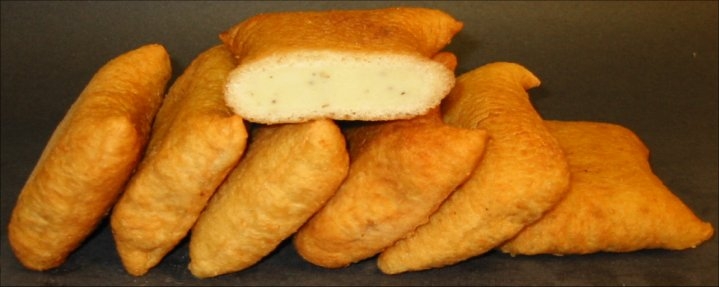
I recently visited Port Richmond High School, and I learned that I have been eating a certain food the wrong way my entire life. I walked into the school’s culinary kitchen and I sat down to eat the food my mentee and his classmates have prepared for my Wagner classmates and I to enjoy. One of the students brought a tray of snacks that looked delicious just from the aroma that it provided. When I asked my mentee (Erik) what they were, he said that they were just a simple knish. I was completely shocked by this; I never had eaten a knish like these before. These knishes were little potato balls made with starch and flour; they also were pointy at the top. My entire life I have been eating knishes that were flat squares and these knishes that I have been eating my whole did not even closely resemble the ones that were provided to my classmates and I that day. I had to even ask the students if these were what actual knishes looked like; sure enough, they had told me that these were traditional knishes. I was so upset that I had been eating knishes wrong my whole life! I was now so intrigued by these knishes that I just had to try them. Sure enough, these knishes were so soft and delicious. It was simple food made with flour, starch, and potatoes, but it was one of the best foods that I have eaten that whole week. What made this food even better was that I was able to eat the knishes with ketchup. I made sure when I got home that day to call out my mom and tell her that she had been giving me “fake” knishes to eat my entire life.

These are the type of flat knishes that I have been eating my entire life.

Is “Food Porn” Making Us Fat?


An example of food porn: a double bacon juicy cheeseburger with fries.

An example of food porn: a double bacon juicy cheeseburger with fries.

I had come across this blog on the foot network about recent research revealing significant “physiological and neurophysiological changes seen in response to food images.” Food porn is basically self-explanatory. It is essentially the visually pleasing and stimulating images of delicious-looking, usually unhealthy (high sugar desserts or high fat meals) foods. This interesting research describes the brain’s reaction to seeing food porn, and why this may have detrimental side effects.

As we have learned, when seeing images of food we enjoy, parts of our brain associated with hunger light up, thus making us want want to devour these foods. Since most food porn images are unhealthy, looking at food porn is potentially dangerous. While I was reading this blog, there was a slideshow of delicious-looking foods that actually made me want to go out and eat them.

An example of healthier food porn: popularly trending now, chia seed breakfast yogurt and fruit bowls.

An example of healthier food porn: popularly trending now, chia seed breakfast yogurt and fruit bowls.

The blog I read acknowledges the research about how food porn has the potential to increase eating, which could lead to overeating; however this blog also proposes a new idea. The idea that if individuals see food porn of healthy food, this may make them want to eat the healthy food. This concludes that whatever kind of food the viewer is seeing, that is the kind of food they are going to want to eat.